


Picture your next cleaning day, including everything before and after the robot enters the water.
A Corded Robotic Pool Cleaner avoids battery charging breaks; a cordless model removes the floating power cable.
Your better choice depends on which routine fits your pool and schedule.
Start Here: Which Inconvenience Would You Rather Manage?
Both designs automate underwater cleaning, but they leave different tasks for the owner. A corded robot connects to an external power supply through its supplied cable. A conventional cordless robot uses a rechargeable battery during cleaning.
Neither arrangement tells you how well the brushes, navigation, or filter perform. Start with the practical tradeoff, then investigate the exact models.
Your priority | Start by considering | Confirm before choosing |
|---|---|---|
Repeat cleaning without waiting for a recharge | Corded | Supported cycles, cable reach, and filter access |
Avoid handling a floating cable | Cordless | Charging routine, retrieval, and mode-specific endurance |
Reach walls and scrub the waterline | Either | Explicit coverage and surface compatibility |
Reduce physical handling | Either | Drained weight, grip, retrieval method, and storage route |
For example, excellent battery endurance cannot compensate for unsupported pool surfaces. Equally, external power cannot make a short cable reach the far corner.Corded vs. Cordless Robotic Pool Cleaner: Which Is Right for Your Pool?
Picture your next cleaning day, including everything before and after the robot enters the water.
A Corded Robotic Pool Cleaner avoids battery charging breaks; a cordless model removes the floating power cable.
Your better choice depends on which routine fits your pool and schedule.
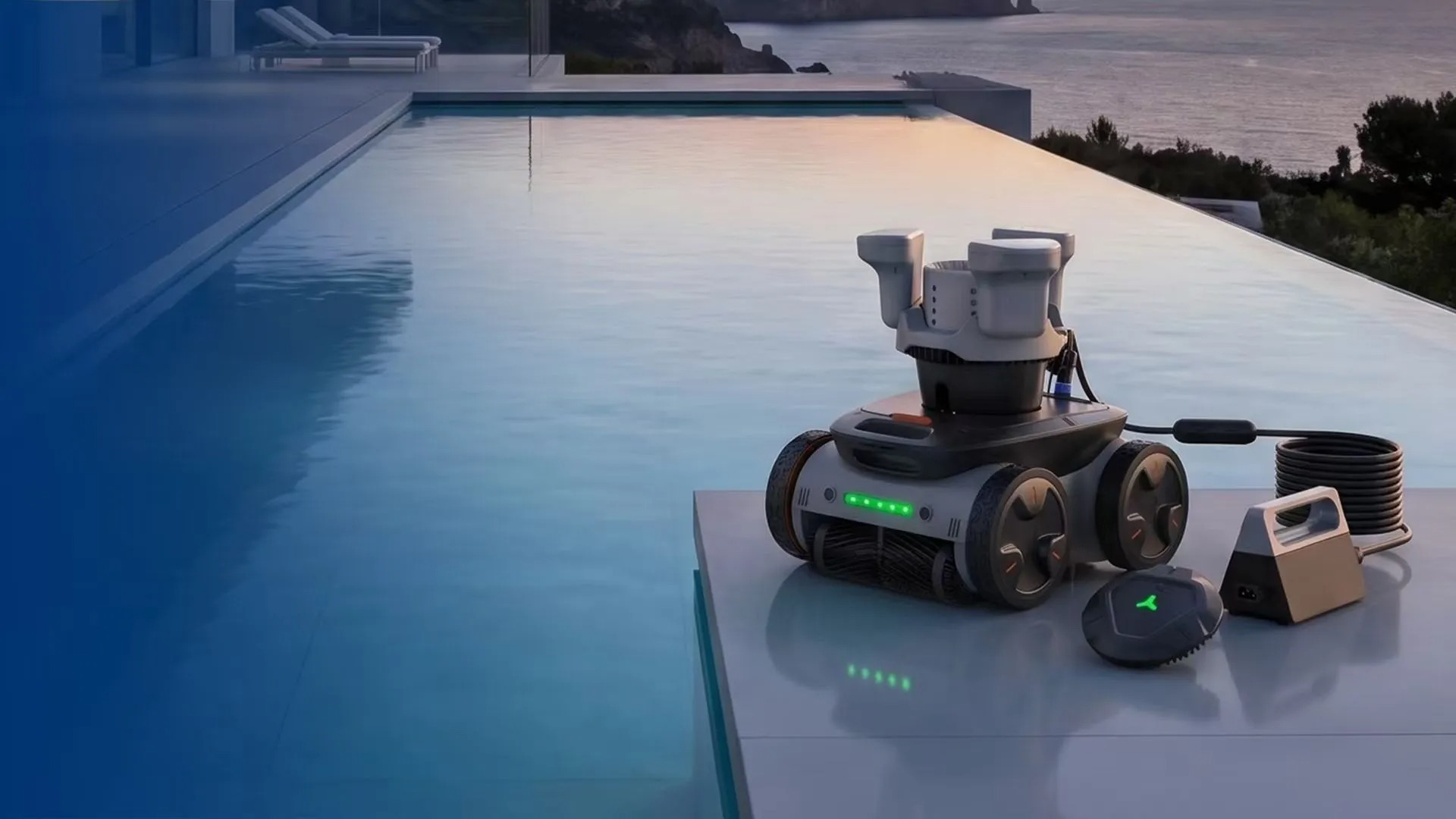
Start Here: Which Inconvenience Would You Rather Manage?
Both designs automate underwater cleaning, but they leave different tasks for the owner. A corded robot connects to an external power supply through its supplied cable. A conventional cordless robot uses a rechargeable battery during cleaning.
Neither arrangement tells you how well the brushes, navigation, or filter perform. Start with the practical tradeoff, then investigate the exact models.
Your priority | Start by considering | Confirm before choosing |
|---|---|---|
Repeat cleaning without waiting for a recharge | Corded | Supported cycles, cable reach, and filter access |
Avoid handling a floating cable | Cordless | Charging routine, retrieval, and mode-specific endurance |
Reach walls and scrub the waterline | Either | Explicit coverage and surface compatibility |
Reduce physical handling | Either | Drained weight, grip, retrieval method, and storage route |
For example, excellent battery endurance cannot compensate for unsupported pool surfaces. Equally, external power cannot make a short cable reach the far corner.
Six Moments That Reveal the Better Choice
Monday: You Have Time for Only One Cleaning Session
Start with the surfaces that actually need cleaning. Floor-only operation differs from a cycle covering floors, walls, and the waterline.
For cordless models, match the advertised endurance to the selected mode. A maximum runtime may apply to floor cleaning rather than wall climbing.
The deciding question: Can this model complete your required coverage before you need it available again?
A corded model removes the need to budget battery energy between charges. It still follows programmed cycles and needs filter care; external power does not mean nonstop cleaning without intervention.
Tuesday: Leaves Arrive Faster Than You Expected
A pool under trees creates a collection problem as well as a power question. Large debris can fill a basket before the robot finishes its programmed session.
Check the intake opening against your common debris.
Compare basket access and usable collection space.
Confirm which filter captures the fine dirt you notice.
Power source alone does not establish these capabilities. A cordless machine can have fine filtration, while a corded model may need a different filter insert.
Ask what happens when the basket loads up. More available operating time cannot replace emptying a full basket.
Wednesday: You Want Another Pass Immediately
This is where power design becomes particularly relevant. A corded robot can begin another supported cycle without waiting for its battery to recharge.
A conventional cordless unit needs sufficient remaining charge or a charging interval. Check the actual recharge time alongside cleaning time.
Count retrieval, draining, filter rinsing, and preparation in that interval. If another session must happen before guests arrive, the whole turnaround matters.
Some cordless systems offer docking or other charging arrangements. Verify the exact process instead of assuming every battery robot requires the same manual routine.
Thursday: The Cable Becomes Your Least Favorite Chore
A floating cable adds setup and storage work. Its reach must suit the pool and the permitted position of the power supply.
A cordless robot removes that moving tether during cleaning. That can be useful when cable handling is the reason you keep postponing maintenance.
Check the replacement chore: Where will the robot charge, and how will you move it there?
Compare the walk, lifting points, drainage, and storage space. Cable-free operation does not automatically mean a lighter robot or effortless retrieval.
Friday: The Robot Misses a Step or Curved Corner
An awkward pool shape is a coverage challenge for either design. Removing the cable does not guarantee stair cleaning or access to shallow ledges.
Ask the seller to address your pool's actual obstacles:
Confirm the supported depth and surface materials.
Describe steps, benches, slopes, and shallow platforms.
Request evidence showing comparable features being cleaned.
Navigation, traction, brush contact, and geometry all affect the result. Treat floor, wall, waterline, and floating-surface cleaning as separate capabilities.
Saturday: You Want Cleaning to Happen Without Reminders
Scheduling depends on the robot's controls and operating instructions. Some corded models offer timers; cordless automation varies by charging and standby design.
An app button is not evidence of a fully unattended routine. Ask whether the robot can start the intended program under your real operating conditions.
Also confirm whether it may remain submerged between sessions. Follow the supplied manual rather than assuming any robot can stay in the pool indefinitely.
Tip: Choose the routine you will repeat consistently, including filter cleaning and putting the equipment away.
Three Pools, Three Different Decisions
The following decision cards describe hypothetical situations, rather than customer results. Use the closest match to identify what deserves testing first.
POOL A — A large pool with frequent debris
The owner wants repeated floor and wall cleaning during a busy week. An approved power location is available, and cable storage is manageable.
Start by considering corded for repeated cleaning. Removing recharge delays can simplify repeated sessions, provided coverage, reach, and filtration match the pool.
What could change the answer: A suitable cordless model may finish the required work with sufficient endurance and practical turnaround.
POOL B — A smaller pool where the cable discourages cleaning
The owner usually needs one routine session and has a convenient charging location. Handling and coiling a cable creates the biggest frustration.
Start by considering cordless for convenient deployment. Cable-free deployment may make the routine easier, if the chosen mode completes the required surfaces.
What could change the answer: Difficult retrieval, awkward storage, or slow turnaround may cancel that convenience.
POOL C — An irregular pool with benches and shallow areas
The owner cares most about areas missed by an existing cleaner. Neither power arrangement establishes whether a replacement can handle those features.
Start by testing coverage for the difficult areas. Eliminate incompatible models before comparing cable management with battery care.
What could change the answer: A demonstration may reveal that either shortlisted model needs manual help in specific areas.
Read These Sales Claims With a Red Pen
Sales claim | Better question for the seller |
|---|---|
Corded always means stronger cleaning | What pickup and brushing evidence supports this exact model? |
Cordless cannot collect fine debris | What filter is supplied, and what does it capture? |
No cable means complete pool coverage | Which surfaces, steps, and depths are explicitly supported? |
Longer runtime means a cleaner pool | What areas are covered during the quoted cleaning mode? |
App control means effortless automation | Which actions still require retrieval or manual preparation? |
One design always costs less | What are the comparable purchase, service, and energy costs? |
Published pump flow can inform a comparison, but it does not measure the whole cleaning result. Brushes, intake design, filtration, and route coverage also matter.
Do not compare isolated flow figures as if testing conditions were identical. Ask whether quoted results come from comparable methods and the same operating mode.
Electrical arrangements deserve similar precision before installation. Corded robots typically use a manufacturer-supplied power unit rather than exposing the robot directly to mains voltage.
Check required electrical protection, placement clearances, and cable instructions in the exact manual. For example, Maytronics guidance calls for protected outlets and discourages extension-cord use.
Note: Follow model-specific operating and charging instructions; a category comparison cannot replace the supplied manual.
Price the Routine, Not Just the Robot
Compare ownership costs over the same intended period. Include the components and maintenance each shortlisted model actually needs.
At purchase: Compare equivalent cleaning coverage, included filters, accessories, delivery, and warranty terms. A lower price with floor-only coverage is not equivalent to a model meeting your wall-cleaning requirement.
During use: Both designs require energy and filter care. Cordless robots use electricity when charging; their energy costs do not disappear because the cable stays outside the pool.
When service is needed: Ask about battery replacement for cordless models and cable or power-unit replacement for corded models. Check availability, labor, and warranty exclusions rather than assuming fixed replacement intervals.
Battery serviceability can affect long-term value, but it does not predict the entire robot's lifespan. Corded robots also contain components that can wear or fail.
Record the delivered purchase price for equivalent required coverage.
Estimate energy use using documented or measured consumption.
Add expected consumables and service using actual supplier quotations.
Keep uncertain repair allowances separate from confirmed costs.
Consider your own handling time alongside the financial figures.
Run a Two-Model Poolside Test Before Buying
Shortlist one suitable robot from each power category. Give both sellers the same pool description and required outcome.
Your pool brief should include these details:
Provide pool dimensions, depth range, shape, and surface material.
Identify whether floors, walls, waterlines, or floating debris need attention.
Describe recurring leaves, grit, and other collected material.
Explain available power placement, charging space, and retrieval access.
State how often cleaning must happen between swimming sessions.
Then compare the full experience in order.
Before entry: Check preparation, controls, approved power arrangements, and whether charging is complete.
During cleaning: Observe coverage of required surfaces and handling of representative debris. Compare outcomes rather than expecting identical movement patterns.
After cleaning: Inspect remaining debris, empty the filter, retrieve the robot as instructed, and prepare it for storage.
Record the work left for you after each test. A clean floor with missed walls may be acceptable for one buyer and unsuitable for another.
If a demonstration is unavailable, request written compatibility answers and review the return conditions. A pool-specific answer is more useful than a category-wide promise.
Conclusion
Choose corded when repeat cleaning and avoiding recharge delays matter most, provided the cable arrangement suits your pool.
Choose cordless when removing cable handling improves your routine and the exact model meets your coverage needs.
Share your pool requirements with Addotron Robotics and compare suitable configurations against the same cleaning checklist.
FAQ
Q: Is a Corded Robotic Pool Cleaner better for larger pools?
A: A Corded Robotic Pool Cleaner avoids battery recharge delays, which can help with repeated or longer cleaning requirements. Its rated pool size, cable reach, and supported surfaces still matter. Some cordless models may also meet larger-pool needs.
Q: Can a Corded Robotic Pool Cleaner run without stopping?
A: A Corded Robotic Pool Cleaner follows its programmed cycles and the manufacturer's operating limits. External power removes battery charging as a constraint, not the need for filter care. Confirm repeat-cycle and storage instructions before planning the routine.
Q: Does a Corded Robotic Pool Cleaner always collect finer debris?
A: A Corded Robotic Pool Cleaner does not automatically provide finer filtration. Compare the supplied filter, intake, and demonstrated debris collection for each model. Cordless cleaners can also offer fine-particle filtration, depending on their design.
Q: Is a cordless pool cleaner easier to retrieve?
A: A cordless pool cleaner removes the floating power cable but may still require lifting and draining. Compare the retrieval method, handle access, drained weight, and storage route. Convenience depends on the exact robot and your poolside arrangement.
Q: Which robotic pool cleaner has lower ownership costs?
A: Robotic pool cleaner ownership costs depend on price, energy, consumables, service, and replacement-part availability. Compare equivalent cleaning coverage over the same period. Neither power arrangement establishes a universal cost advantage.